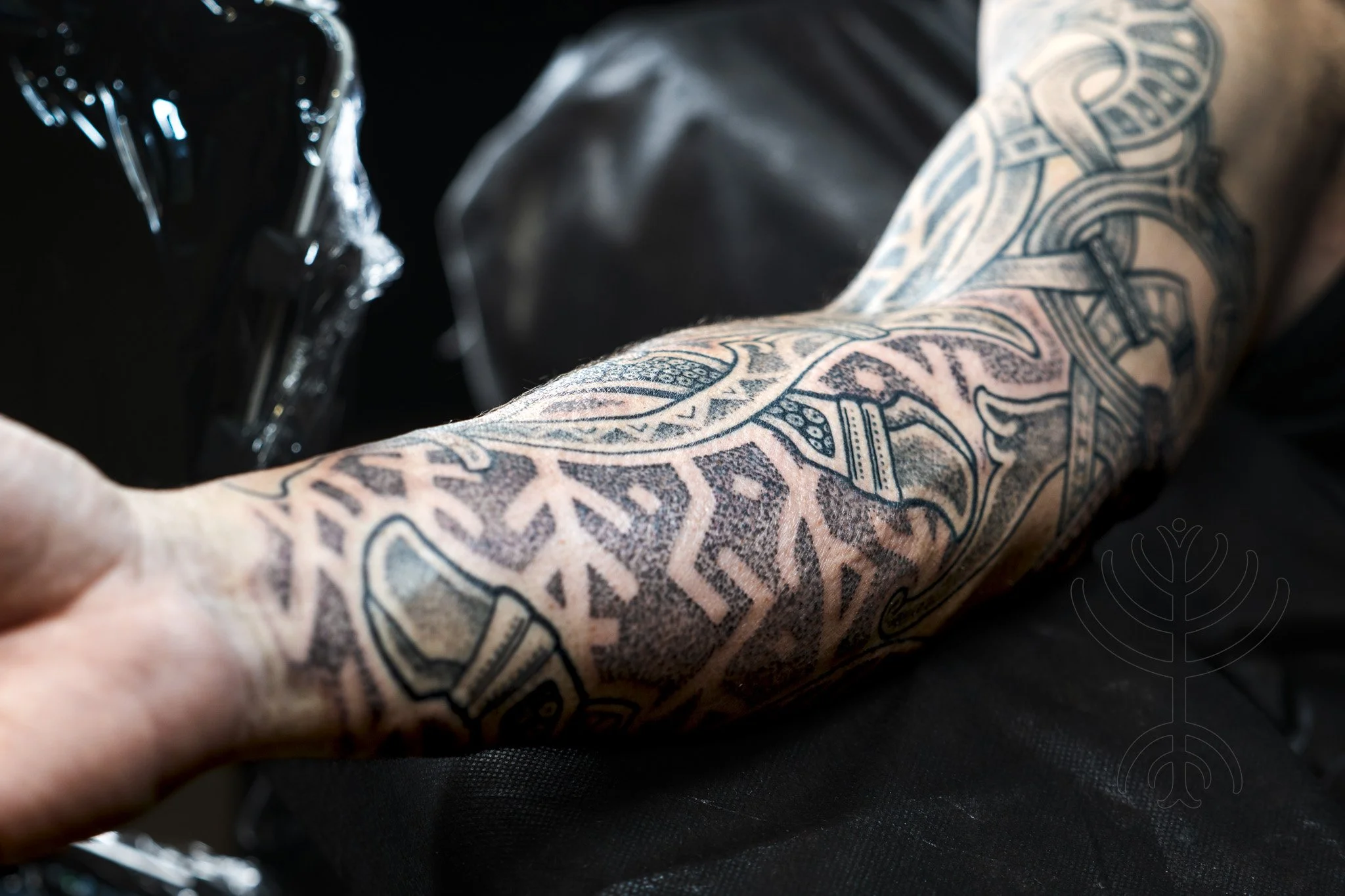
What Working Together Looks Like
Custom tattoos are collaborative by nature. This page explains how we typically move from idea to finished tattoo.
The Ancient Marks Process - From conception to fully healed tattoo — A guide to amazing ink.
This is a long read… But below is the rrough roadmap of the Ancient Marks process, a process that is always evolving in order to be more efficient for each client.
Jon wants you to know what to expect when working on a custom project with us. Tattoos can be deeply personal, and larger pieces often involve a lot of moving parts, planning, and collaboration along the way.
That said, not every project is extremely complex. Sometimes it’s a full multi-session-block sleeve, and sometimes it’s as simple as coming in for a small BindRune or meaningful symbol one afternoon randomly.
Every project is approached differently depending on the scale, goals, and needs of the client.
What to Expect When Working With Jon Poulson over the coming months…
Ancient Marks is built around large-scale, custom tattoo work rooted in symbolism, flow, storytelling, and collaboration. Because of that, the process is a bit different than a standard tattoo appointment you may have experienced; especially for Nordic, tribal, ornamental, and large Ornamental-flow based projects.
This page is here to help you understand how the process works, what to expect, and why things are structured the way they are.
Ancient Marks operates in Jon’s private Studio Space adjacent to and part of Aloha Tattoos in Murray, Utah. While the studio supports some aspects of the process, all Ancient Marks projects are personally developed and directed by Jon Poulson.
Step 1: Submit the Inquiry Form
Every project begins with an Inquiry Form.
This helps us gather the foundation of the project before moving into consultations. The more information you provide, the smoother the process becomes. We have decades of experience with these projects. We know the questions to ask and how to create a lasting, timeless design that fits your body.
Helpful things to include:
Placement Preferences
Approximate size
Symbolism or meaning
(keywords or key concepts)Reference images
(5-10 typically)Existing tattoos nearby that may interfere with the flow of this piece
(Do you want to Cover, Keep, Rework?)Budget expectations
Basic Pricing GuideTimeframe - your expectations, or your preferred time to start, or complete the project.
Photos of the area to be tattooed
See the inquiry form for what we are looking for
The goal at this stage is not perfection — it’s initial clarity and direction.
Step 2: Initial Consultation
After the inquiry is reviewed, you may be scheduled for an initial consultation.
This consultation is primarily used to:
Explore ideas
Discuss keywords, symbolism and direction in a broad sense
Review references giving suggestions on how and where to find inspiration as necessary
Talk through this process on a broad level
Answer general questions before the process be
Some projects are simple. Others require substantial planning, research, and collaboration. This first conversation helps establish that roadmap.
Step 3: Project Approval by Jon
Not every project moves into scheduling. There are many factors that play into this.
Ancient Marks focuses heavily on intentional, large-scale, and custom work. Before moving forward, Jon reviews the project to determine:
Artistic fit
Scope of work
Timeline expectations
Design direction
Overall feasibility
Once approved, the project moves into the planning phase.
Step 4: Consultation With Jon
This is where the project becomes real.
During this stage, we discuss and eventually finalize:
Project direction
Tattoo placement and flow
Estimated pricing structure
Session planning
Design priorities
Overall strategy for completing the work
This consultation is often more logistical than artistic. The purpose is to meet each to create a realistic game plan before the tattooing process begins.
Step 5: Retainer & Scheduling
Large-scale Ancient Marks projects require a retainer which is used as a deposit for your sessions, and the time spent developing your concept.
Jon’s current retainer is $1,200 and is used to show your commitment to the project.
This Retainer goes toward:
Drawing and design time
Tattoo deposits
Project preparation
Research and Development
Planning, Scheduling, and Communications
Leaving the Service Retainer allows Jon to begin dedicating focused time to your project long before the tattoo starts. By the time we start the drawings, it’s mostly mapped out and options for design have been considered, and alternative designs contemplated.
Once the retainer is received:
Initial Tattoo dates are Finalized in our system
Drawing sessions are Scheduled and planned.
Long-term project structure is established
Creativity is dedicated to the project
A Simplified Process For Larger Projects
Over the years, the process has evolved significantly.
The older system often required multiple appointments, 1 session at a time, healing periods of 2-4 weeks between each. Proceeded by multiple design and re-design sessions before tattooing (or scheduling) could truly begin. After that it took up to, and over a year to complete each sleeve or Backpiece. While that approach worked, it became extremely time-consuming for both the client and the artist.
The current process is designed to simplify larger projects while still keeping the work highly custom and collaborative. This process is used by many top artists around the world, and has been passed along to Jon this past year.
Instead of endlessly preparing before tattooing starts, many projects now begin with:
2–3 consecutive tattoo days (Session Blocks) Repeated as necessary to complete the project
Strategic planning beforehand; Design and Logistics
Drawing sessions scheduled closer to the tattoo dates to keep the inspiration alive
Real-time refinement directly on the body
This approach allows the work to evolve more naturally while maintaining momentum throughout the project.
Step 6: Drawing Sessions
Drawing sessions are a major part of the Ancient Marks process.
The first drawing session is usually done:
In person, at the Shop
Or over Google Meets (or Zoom) for traveling clients
The first one solidifies the Vision; Allows for a tracing of the area to be tattooed so it is drawn for your body specifically. Taking into account anything that may enhance or add to the tattoo.
You don’t need to stay the entire time, it gets boring watching concepts come to life at first. it’s a lot of scribbling, erasing, looking through references, finding new references, etc… IT just gets Jon’s mind wrapped around the project. — then it marinates for a week or so.
After that, follow-up drawing sessions are completed by Jon alone so he can focus deeply on the structure, flow, and detail work without interruption.
Most Ancient Marks projects are drawn directly on the body for that body from the sketches and drawings created at these drawing sessions. Because of that, early sketches may appear rough or incomplete outside the final context of the body itself.
Without the full body flow, layering, and final detail work, it can sometimes be difficult to fully visualize the final outcome from a flat drawing alone.
We can often provide you with a 3D mockup of the project once it reaches a certain point. This is a perfect way to visualize its flow properly. Most times a flat sketch does not convey how a piece flows with your specific anatomy, and can look “off” until you see how it flows and why things are drawn the way they are.
We generally do not provide concepts that include the detailed fills as a part of the drawing process. If you want this, it can be done with planning, but does cost extra to explore ideas on paper before committing to skin. Generally, these details are drawn directly on as the tattoo progresses. ( we can provide pictures or video of past projects to show you how this process unfolds).
Clients who have placed a retainer, or payed outright for the drawing time are welcome to review progress drawings throughout the process as it unfolds. Sometimes things change drastically between the 2nd and 3rd drawing session. — Exciting stuff.
**See the section towards the bottom regarding Drawings.
Step 7: The Tattoo itself. Tattoo Session Blocks or Single Sessions
Once the project is planned, drawings are underway, and the sessions or Session blocks are scheduled, the tattooing process begins. Larger Ancient Marks projects are commonly broken into 2–3 day session blocks instead of scattered single appointments.
While that can sound intimidating at first, it actually allows us to create stronger overall flow, reduce unnecessary healing cycles, and build the tattoo more naturally as a complete piece instead of disconnected sections. Day 1 is usually focused on refining the design directly on the body, adjusting flow, applying stencils where needed, and lightly mapping major portions of the tattoo with minimal skin trauma to create a roadmap for the following days.
From there, the remaining sessions are used to progressively build the tattoo details depending on your pain tolerance, skin condition, healing response, and overall progress. Some projects are approached section-by-section, fully lining and finishing areas as we move, while others are first structurally lined before heavier detail and fills are added later. The goal is never to rush the process, but to create intentional progress while keeping the tattoo looking solid and cohesive throughout each stage of the project. Between session blocks, we evaluate healing, remaining work, and future planning before continuing forward.
Smaller projects are often done the same way, but can often be done as single day, or half-day sessions.
Large-Scale Tattoos Take Time
Ancient Marks projects are not “one-and-done” tattoos.
Many pieces are built in layers over multiple sessions, especially:
Sleeves
Bodysuits
Backpieces
Nordic Motifs
Viking Knotwork
Pagan Imagery
Ornamental Tribal
Geometric section structures
Ornamental compositions
The focus is not speed, it’s longevity, cohesion, and intentional design.
Good tattoos age well because they are planned carefully and executed with precision and intention with detailed knowledge of the subject matter and the flow of your anatomy. We want this to become a part of you.
Tattoo Session Blocks:
What Multi-Day Sessions (Session Blocks) Actually Look Like
One thing that surprises many clients is that large Ancient Marks projects are often completed in structured 2–3 day session blocks instead of scattered single appointments stretching into the horizon.
For some people, that idea sounds intense at first - but in reality, this approach is often easier on the body, creates better flow throughout the tattoo, reduces unnecessary healing cycles, and allows the project to develop more naturally as a complete piece instead of disconnected sections.
These sessions are designed intentionally. This is not about rushing a tattoo. It is about creating a roadmap for large-scale work while minimizing unnecessary trauma and maximizing momentum.
Some clients still opt to do single Full-Day Sessions, with Healing between, and spread them out over the months. We are just fine with this as long as you are aware of the timeframes involved and commit to consistency over the coming year or years.
Before Your Tattoo Session…
Hydration matters more than most people realize.
Clients who hydrate heavily for 1–2 days leading up to the session and continue to hydrate during the session, and subsequent session block, always sit better, heal better, and feel better throughout the process.
We also strongly recommend:
Good sleep - More than normal. Rest = Less pain, and more relaxed sessions.
Proper meals - Balanced clean food. Avoid junk food please.
Electrolytes - coconut water is great for this
Avoiding alcohol beforehand - 24 hours prior please. it thins your blood and causes improper healing in most cases.
Bringing snacks and drinks that you love. - Clean snacks will be available at no charge. But bring something to keep that blood sugar up.
NSAID’s as needed for days 2 and beyond. - Ibuprofen and Tylenol help with the swelling.
This is a marathon, not a sprint. Headphones, a good book, delicious snacks, podcasts and music all help the experience more pleasant. Prep for it appropriately. Bringing a friend can help distract, but can also be a distraction.
3-Day Session Blocks
Session Block Day 1 — Mapping The Project
The first day is usually the lightest physically, but one of the most important creatively. There is a lot of standing and getting drawn on. Some decision making, and always a few curveballs to solve.
This is where we:
Refine the design
Adjust body flow
Draw directly onto the body
Build stencils where needed
Finalize composition in real-time
Once everything is flowing correctly, we begin lightly establishing the tattoo.
In many cases, this means:
Mapping major elements through Dot-Lining (small stippled dots every few millimeters)
Light structural dots that read like a roadmap of whats coming to life
Establishing guides for later sessions while limiting trauma to the skin — this is the secret that allows us to work in blocks.
The goal is to create a full roadmap for the project while causing as little trauma to the skin as possible.
Because these “lines” are intentionally lighter, with space between, they can easily be refined, strengthened, or tattooed over during the following days.
At the end of Day 1, we usually apply one of our preferred healing barrier products along with instructions for the next morning.
Ink Beetle - A natural tattoo barrier that easily washes off (Click here to read about Ink Beetle during session blocks)
Derm Armor — a light pad similar to that beneath meat at the supermarket that covers, protects and eliminates blood and plasma. Taped into place overnight and usually used if we have planned on going beyond 3 days in a session block for days 3,4 and even 5.
Session Block Day 2 — The Heavy Push
Day 2 is usually where the majority of the actual tattooing happens.
At this stage, we decide together which direction makes the most sense based on:
Pain tolerance
Swelling
Energy levels
Skin condition
Overall progress from Day 1
Expectations from the session block
From there, we generally take one of two approaches:
Option 1 — Build The Tattoo Section By Section
We begin at either the top or bottom of the project and progressively:
Bold-line
Shade
Stipple
Fill
Refine
Completing sections in turn, moving methodically toward a goal for the day or session block.
Option 2 — Fully Establish The Structure First
If the body needs a slower approach, we may instead:
Bold-line the majority of the project
Finalize structural details
Add supporting linework
Create a stronger overall framework before heavy filling begins
This approach can make the remaining session blocks smoother and easier on the body long-term.
Throughout the process, we use specialized towels and techniques to help reduce irritation, trauma, and overall discomfort as much as possible.
Most Day 2 sessions involve roughly:
5–7 hours of active tattooing
Lunch breaks
Snacks
Restroom breaks
Short recovery pauses as needed
There is no prize for suffering through it. The goal is steady, quality work. We generally do not recommend numbing agents, but limited use at the end to achieve goals is not unheard of. Be aware that numbing agents do come with risks both physical, mental, and healing risks. We ask that you make yourself aware of these risks ahead of time. If you are planning on using numbing agents, please discuss with Jon ahead of time so we can make an informed decision together.
Session Block Day 3 — Refinement & Completion
Day 3 is flexible and depends entirely on how the project and body responded during the first two days.
If we spent Day 2 fully establishing the structure of the tattoo, and Bold-Lined the piece, Day 3 may involve:
Finalizing the Bold-Lines
Adding final knot work details
Finalizing any remaining lifework
Adding texture - if you feel up for it
Avoiding already tattooed areas or sections we have already detailed.
Beginning fills on major elements to bring it to life instead of working up or down, focusing on one element at a time.
Cleaning up remaining transitions and ensuring the lines look their best
If it’s too much and day two was your limit, we will spend some time developing the remaining elements or fills off the body in preparation for the subsequent sessions.
Discuss tolerances, expectations, and adjust as necessary for future sessions.
In some cases, if swelling or sensitivity is high, we may shorten the day or postpone portions until the next session block.
If the tattoo progressed smoothly during Day 2, then Day 3 often continues the same momentum:
Moving upward or downward through the composition
Filling sections moving to adjacent areas as we progress
Developing texture and depth with Dot work and layering techniques
Expanding the completed areas
Finalizing any pieces or Knotwork as we progress.
start planning background if we haven’t added it as we move through sections.
The goal is always to leave the tattoo looking intentional and solid at the end of each session block — not unfinished or chaotic.
There is no rush. Slow is smooth, smooth is fast.
Many Day 3 sessions fall on Sundays and are intentionally more relaxed.
After completing the Session Block, you will need to heal. Healing for session blocks generally takes a minimum of 2 weeks, but we Prefer 4 -6 weeks for best results. the way you heal will affect the look of the tattoo over the years.
Session Block Day 4… and Beyond
Some clients want to push the project as far as possible in a single trip. Extended 4–5 day session blocks are available by special request only and are usually scheduled starting mid-week.
In certain cases, 4 and even 5 day session blocks are possible, and Jon has completed a handful of these over the years for large-scale projects and traveling clients. That said, these longer sessions are not typically recommended for beginners or for the faint of heart.
The process continues much the same as Day 3:
Refining the rest of the design
Avoiding the areas we have already tattooed
Adding detail and texture to places we have not finished (the remaining dot-lined areas)
Tying the composition together carefully - usually smaller details and outer background elements
While some clients handle extended sessions extremely well, we have found that 2–3 consecutive days is usually the optimal balance between progress, healing, and overall skin condition. Large-scale tattoos place substantial stress on the body, and longer sessions can become physically and mentally taxing.
Because of that, if you want this tattoo done quickly, we often recommend:
Completing a strong 2–3 day block
Healing for 2–3 weeks
Returning for another focused session block
Days 4 and 5 are often approached more conservatively and may simply be used to tie up loose ends, refine details, or make the tattoo feel complete, or outright finishing the piece in one go.
There is no rush. healing between sessions has unseen advantages, and generally results in a better piece in the long run.
2-Day Session Blocks
A 2-day block follows the same overall structure, simply without the third refinement day.
These are common for:
Those nervous about 3 days
Budget allows for 2 days, not 3
Smaller sleeves
Partial projects requiring more that 1 day
Returning clients
Simpler compositions
Clients with tighter schedules
1-Day Single Full-Day Session
Not every project is completed in multi-day session blocks.
Some clients prefer to take the process one session at a time, and that approach works perfectly well for many projects. In these cases, the process follows the same overall structure as the larger session blocks; just spread out over a longer timeline with healing periods between appointments.
The first full-day session is usually focused on:
Refining the design directly on the body
Adjusting overall flow and composition
Applying stencils where needed
Establishing the structural roadmap of the tattoo
Depending on the project, this may involve:
Dot-lining and lightly mapping major sections with minimal skin trauma
Beginning more developed linework immediately
Establishing major focal points and composition flow
From there, future sessions continue progressively in much the same way as the multi-day blocks:
first establishing stronger structural linework before building additional detail later
Then Working section-by-section filling as we move Through.
major elements first, then lesser elements at later sessions
The primary difference put simply is pacing.
Instead of consecutive tattoo days, single-session projects typically allow:
2–4 weeks of healing between appointments
Additional time for swelling and recovery
More flexibility for scheduling and budgeting
This gives the body time to recover while still allowing the project to evolve naturally over time. As each session progresses, additional elements may still be drawn directly onto the body to maintain flow, cohesion, and proper composition throughout the piece.
This is a more traditional approach, but it usually takes longer overall and can occasionally interrupt some of the artistic momentum that naturally develops during dedicated multi-day session blocks. With weeks between appointments, other projects and daily life can sometimes pull focus away from the piece compared to spending several consecutive days fully immersed in a single tattoo.
That said, single full-day sessions are often:
Easier on the body for some clients
More manageable for certain schedules
More budget-friendly when spacing sessions out over time
Every project, and every client, is different. The goal is always to find the approach that makes the most sense for the tattoo, the timeline, and the person wearing it.
Step 8: Continuing The Project - Subsequent Sessions
After each session block, we evaluate:
Healing
Progress
Remaining work
Future scheduling
Design needs moving forward
Some projects continue with:
Another 2 or 3 day session block
Several multi-Day session blocks
A single full-day session
Half-day refinements
Additional drawing sessions for complex background work or additions to adjacent body parts (a Sleeve moves onto the hand or chest, or A back piece moves onto the ribs, or up onto the neck, etc…)
As the tattoo evolves, additional elements are often drawn directly onto the body in later stages to maintain proper flow and cohesion.
About Drawings & Design Ownership
Some clients prefer seeing finalized drawings before committing to tattoo sessions.
While this used to be the standard approach, large-scale body-flow work has evolved significantly over the years. Much of the final composition now happens directly on the body because that creates stronger flow, movement, and overall composition.
The purpose of the drawings is to develop your tattoo project prior to putting it on the skin — not to create transferable artwork for outside use.
That said, Jon is still comfortable creating more finalized pre-drawings when requested, including Backgrounds and details.
However, this requires significantly more time and carries additional creative risk since the tattoo itself is not yet guaranteed to happen.
Because of that:
A dedicated Drawing Session Block without tattoo appointments booked will generally require the full retainer as payment upfront as a Drawing Fee.
Future tattoo appointments will still require standard tattoo deposits.
The retainer covers Jon’s drawing time, planning, and creative development.
**It is important that you understand that clients are not purchasing ownership of the artwork itself. You are commissioning Jon’s time, creative process, knowledge, and tattoo development techniques to prepare artwork that is going on you. The tattoo is yours, All artwork, drawings, and concepts remain copyrighted and may not be reused, reproduced, tattooed elsewhere, or distributed without explicit written permission.
Communication & Expectations
Clear communication makes better tattoos.
Clients are encouraged to:
Ask questions
Share inspiration
Be honest about concerns
Trust the process
TRUST the PROCESS
Allow room for artistic interpretation
At the same time, Ancient Marks is not a copy-and-paste tattoo experience. We are not corporate with countless bodies behind the scenes. We are a small family run shop with assistance from the front desk staff at Aloha at times.
The goal is to create something personal, wearable, and built specifically for your body — not simply recreate another tattoo from the internet.
We do our best to stay on top of communication at all times, but between calls, texts, emails, consultations, scheduling, and ongoing projects, we are often managing dozens of clients simultaneously with multiple team members involved throughout the process.
Because of that, occasional delays, missed messages, or communication hiccups can happen. Please don’t take it personally if this occurs — sometimes texts fail, emails get buried, or messages simply don’t make it to the right person immediately.
If you feel like communication has stalled, please reach back out or simply pick up the phone and call us. We are always happy to help and will do our best to get you the answers you need. You are your own advocate when it comes to a tattoo that you want to get. speak up.
When you first contact us, we usually send a vCard with our primary contact information. We suggest you save that to have our numbers, and to know which is which. While texting is convenient, complex ideas, large project discussions, and frustrations are usually better handled through email, phone calls, or consultations, since texts often pass through multiple people and can occasionally create delays or confusion.
We have never once ignored a client - and we never will.
Traveling Clients
Many Ancient Marks clients travel from outside Utah, many from outside of the USA.
Google Meets (or Zoom) consultations are available when needed, and portions of the process can often be handled remotely before arriving for tattoo sessions. Sometimes we take the entire week to move through sketches, drawing/design, and then into the Tattoo Session Block right after. This is a great way to get things done efficiently. But often we do the drawings a few weeks prior to the tattoo block so you have an idea of what were going to put on your body. As stated above, we make the final design the day of the appointment. We do ask that you limit major changes so that we do not have to spend the entire first day re-designing the piece.
If you are traveling, please mention that in your inquiry form, and be clear about this when we talk so scheduling can be planned appropriately.
We can assist you in finding local accommodations if necessary. Many clients stay in the mountains near the shop instead of the city to enjoy nature and have a calm getaway for this process. We just ask that you stay relatively close to the shop; In the greater Salt Lake City area, or one of the Local Canyons; Big Cottonwood, Little Cottonwood Canyon, or Park City, Utah if you opt to stay outside of the Greater Salt Lake Area, including Davis County, or Utah County.
Final Thoughts
The Ancient Marks process is intentionally collaborative, structured, and personal.
Some projects move quickly. Others evolve over time. Every piece is approached differently depending on the scale, symbolism, placement, and goals of the client.
The process exists to create stronger tattoos, better flow, and a more meaningful final result.
If you’re ready to begin, the first step is submitting an inquiry form and starting the conversation. Not all projects require everything above. some projects you can come in on an afternoon, and walk-out with an amazing BindRune tattoo a few minutes later.